
Schenectady Resident Lookup Record Coverage
One name can appear in several Schenectady record systems, but each record has a limited purpose. An assessment entry can connect a recorded owner with a parcel, a situs location, and a tax correspondence address. A deed index can place a person in a dated instrument. A voter match can confirm a registration response, while a court index can show that a public case exists. None is a complete roll of everyone at an address. Begin with the record that fits the question, preserve its date, and use another source before drawing a conclusion.
| Record | What it can confirm | Custodian or route | Access boundary |
|---|---|---|---|
| Assessment and parcel record | Recorded owner, situs, mailing address, parcel key | Beacon and City Assessment | Public roll; it does not establish every person at the address |
| Recorded instrument index | Named parties, document type, recording date, legal description | Schenectady County Clerk SearchIQS route | Free index; images and certified copies have separate rules |
| Voter match | Whether the state tool returns a registration match | New York voter lookup | Protected fields and protected registrations stay out of public display |
| Court index | Public case caption, number, court, date, and status where published | New York eCourts tools | Full files remain with the clerk; protected matters may not display |
| Vital and historical sources | Dated life-event or directory clues | DOH, city registrar, library, archive | Genealogy and certified-copy rules are different |
Use the Beacon property route for a parcel starting point and the County Clerk land-record route for a documented transfer trail. The parcel key, legal description, and record date are often stronger identifiers than a name alone.
Match a Schenectady Resident by Address
When an address is known, keep three fields apart: the parcel's situs, the recorded owner's mailing address, and any registration address. Beacon and the city roll may show the first two, while the City GIS supplies the spatial key that connects a map feature to the assessment record. A mailing address can be outside Schenectady for many ordinary reasons. It is not proof of where the named person is living.
Record the spelling of the name, the parcel or print key, and the date of the roll. Then check a County Clerk instrument for the grantor, grantee, document type, recording date, and legal description. If a record uses a trust, company, initials, or former name, do not collapse it into a person match without a second dated source. The full by-address workflow belongs in the Schenectady Street Directory.
- Situs address
- The physical location of the parcel used by the assessment and map systems.
- Mailing address
- The address used for tax correspondence. It may differ from the parcel location.
- Parcel key
- An assessment or GIS identifier, such as a print key or SWIS/SBL value, used to bridge systems.
Note: An online property result is a dated assessment snapshot, so save the roll date before comparing it with an older deed or directory.
Schenectady Voter Lookup Match Fields
New York's voter tool is a match interface, not a public browse list. It asks for county, last name, first name, date of birth, and ZIP Code; the live page requires cookies and JavaScript. Select Schenectady County and use the person’s own information only. A failed match can reflect a spelling difference, an incorrect ZIP, a protected registration, or a field that does not match the registration record. It does not settle identity by itself.
The New York voter registration lookup shows the field set used for this narrow confirmation step.
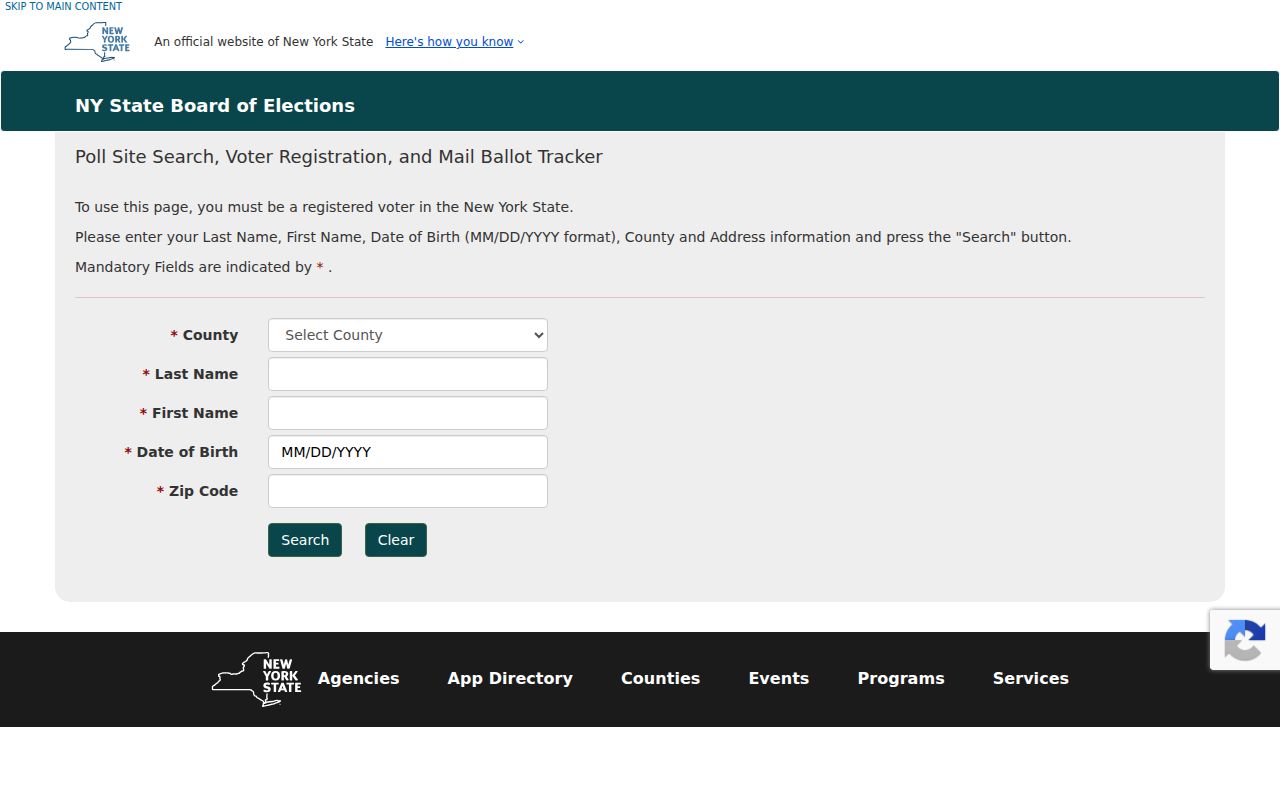
Election Law makes registration records and certain annual lists available under supervision, while keeping identifying numbers out of public view. The county board can explain the current process for a lawful election record request. Annual lists may be arranged by street and number or alphabetically, but their use and distribution have statutory limits.
Search Schenectady Court Records by Name
For a public court check, use the New York eCourts entry point to choose the appropriate service. WebCivil Local accepts an index or case number, party name, attorney, and judge routes. WebCivil Supreme can narrow by Schenectady County, index number, party, attorney, judge, case type, or dates. NYSCEF guest search adds case identifiers, names, county, case type, and date-range paths for participating e-filed cases.
| Result field | What it means |
|---|---|
| Party or caption | The name as the court indexed it, sometimes with a party role. |
| Case or index number | The court identifier used to distinguish a matter and year. |
| Court and county | The selected court location, which helps separate same-name results. |
| Dates and status | Filing, appearance, calendar, or pending/disposed information when the interface publishes it. |
| Documents | Links only where a filing is public. A result does not promise a complete case file. |
Use the Schenectady Surrogate’s Court for an estate question, and ask the clerk about copies or archived material. Sealed, adoption, youth, Family Court, and other protected material may not appear online. A name hit is a lead, not an identity conclusion.
Schenectady Vital Record Paths
Vital material should be approached through the right custodian and access route. The New York State Department of Health Vital Records office handles state-held birth, death, and marriage records outside New York City. For genealogy, its published periods are generally 75 years for a birth when the person is known deceased, 50 years for a death, and 50 years for a marriage when both spouses are known deceased. Direct-line descendants can have an exception when they provide relationship proof.
The city registrar has a separate route for a marriage license issued in the City of Schenectady. Its marriage-certificate instructions describe the local identification and mailed-request process. A historical index, obituary, or newspaper notice is not a certified certificate. For a current certified copy, follow the active form and eligibility instructions from the custodian rather than relying on an index entry.
Note: A genealogy period opens a historical research route, not a general right to receive any current certified record.
Schenectady Resident Lookup Verification Steps
A reliable Schenectady resident lookup compares independent records that share a specific point in time. Start with a full name plus a known address, parcel key, year, company name, or court number. For an older lead, a directory year and street can be more useful than a modern ZIP. Preserve the exact spelling shown in each record, because initials, married or former names, and company names can produce false matches.
- Anchor the name to a dated parcel, deed, directory, or voter-match detail.
- Check a separate record type, such as a court index, business record, or historical notice, for the same address, date range, or family connection.
- Compare record dates before treating two names as the same individual.
- Ask the clerk or other custodian for the underlying file or a certified copy only when that document is needed.
- Docket
- The court's running record of filings, dates, and case events. Online entries can be limited.
- Index and image
- An index points to a record. An image is a view of the underlying document when access is available.
- Certified copy
- A custodian-issued copy with the certification required for the record type. It is not the same as an online screen result.
Schenectady Heir and Classmate Trails
Family-history questions need records that fit the time period. For a possible heir, begin with a deed or obituary clue, then contact Surrogate’s Court about inspection of the estate file and any restrictions. A probate reference can name a decedent, fiduciary, or heir, but it does not supply a present address. For a former classmate, the stronger local trail is yearbooks, city directories, and newspaper material rather than a single current record.
The Schenectady Digital History Archive obituary index and the appointment-based Grems-Doolittle Library are useful offline complements. The Historical Society asks for appointments at least two business days ahead. Its collection can supply family files, maps, city directories, newspapers, wills on microfilm, and finding aids that add context to a dated name.
Schenectady Resident Lookup Fallbacks
An empty screen is not always an empty record. A missing property result may be a municipality or parcel-key mismatch. A missing deed can be older than the unverified online start, or indexed under a trust, estate, company, or name variant. A court result can be in the wrong court or be protected. Move outward through the actual alternatives: contact the assessor or County Clerk counter, ask the court clerk, use library microfilm, schedule the Historical Society, or make a focused records request.
The Schenectady County FOIL request form asks for contact information, request detail, and copy preference. New York FOIL asks a requester to reasonably describe the record. The state’s response rules include an initial response, denial with reasons, or an acknowledgment with an estimated decision date. Describe the record type, person or address, date span, department, and whether inspection or copies are requested.
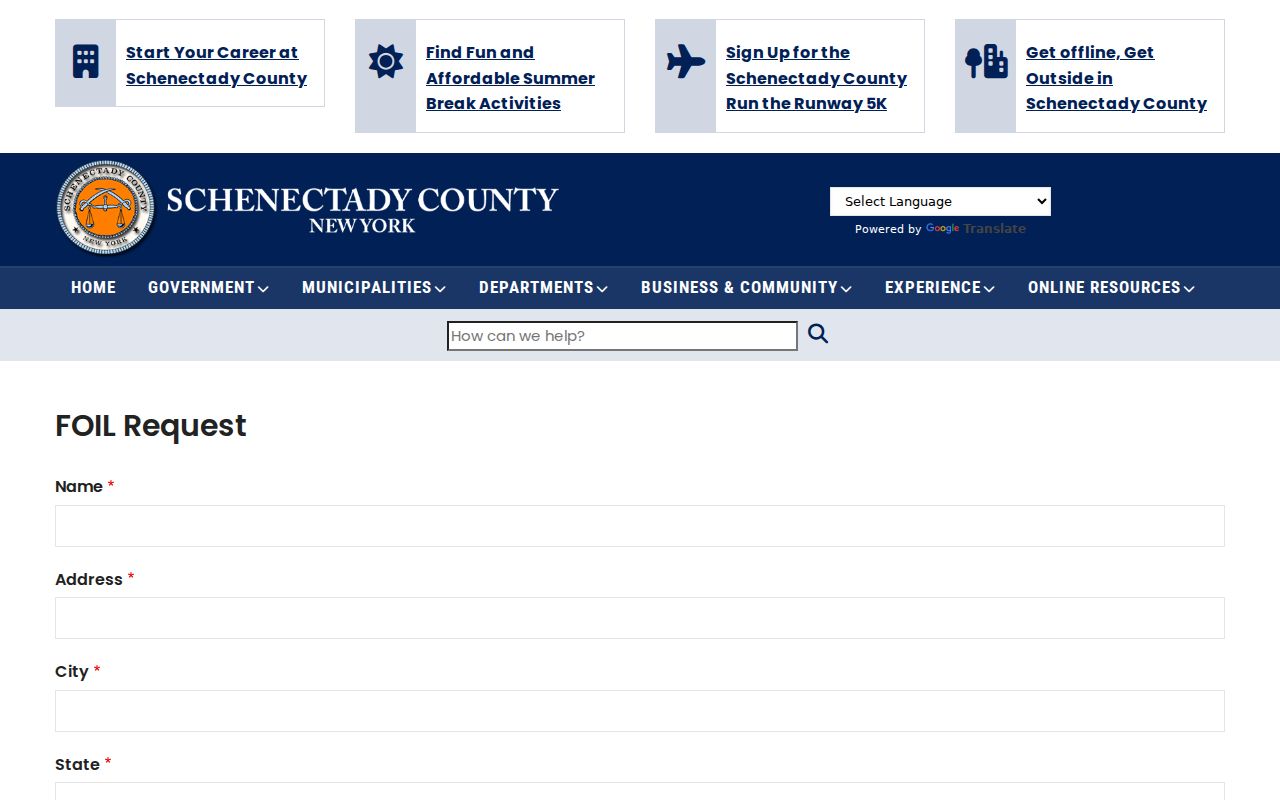
A focused request gives the custodian a practical fallback when a public lookup does not carry the needed record or period.
Schenectady Resident Lookup Privacy Limits
Public access has firm boundaries. The New York Address Confidentiality Program provides a substitute mailing address and mail forwarding for qualifying participants, including through confidential voter-registration coordination. Court systems also keep sealed, adoption, youth, and other protected matters out of ordinary public display. Driver-license numbers, non-driver identification numbers, Social Security numbers, and facsimile numbers are excluded from public voter records.
Lawful use. Use Schenectady records for a narrow, lawful personal purpose. A public result does not permit stalking, harassment, threats, repeated unwanted contact, or redistribution of protected information.
When a record is wrong, document the source and date, then contact the office that maintains it. A suppression request to a compiled-data service cannot rewrite a recorded deed, a court docket, a historical directory, or an official voter record. New York’s current ACP rules mean some correct records will use a substitute address instead of an actual location.
Schenectady Resident Lookup Entity Checks
A business or license record can help distinguish two people with the same name, but it is not a residence record. The New York Department of State entity database can show an organization date, jurisdiction, county, service-of-process address, registered agent, and current status. The NYSED profession verifier can show a public licensee name, profession, registration status, location, original-license date, and discipline summary where published.
Use those records as a dated affiliation check and compare them with a deed, parcel, directory, or court source. The county’s Record Alert service is also worth considering for a person monitoring names in recorded instruments, but a notification should always be checked against the actual County Clerk record before action.
Note: A company address, registered-agent address, or license location may explain an affiliation without establishing a person’s current address.