
Finding Schenectady Residents From a Real Lead
A Schenectady residents directory works best when the search begins with something concrete: a full name, a street address, a parcel key, a directory year, or a court case number. The County Clerk, City Assessor, Board of Elections, courts, and local-history collections keep different parts of the trail. A property record can identify an assessed owner, while a historical directory can place a person at a printed address in a specific year. Neither result proves every member of a household. Use two dated records before treating a name and place as the same person.
For a current question, start with the parcel and confirm the record type. For an older family question, start with a directory or obituary, then move to a deed, probate file, or census reel. Schenectady has useful local shelves as well as online sources, so a failed web search is often a signal to change channels, not to assume that a record never existed.
- Use the City GIS or Beacon property route to match the address to a parcel and separate the situs from the tax mailing address.
- Search County Clerk instruments by party name and date, preserving the recording date and legal description with each hit.
- Use the New York voter match only as a limited civic-record confirmation, with the required name, county, birth-date, and ZIP inputs.
- For past Schenectady residents, consult the local directory run, criss-cross volumes, newspaper index, and census microfilm.
- When the index does not reach the needed period, ask the custodian, library, Historical Society, or a FOIL office for the specific record and date range.
Schenectady Resident Records Offices
The offices behind a Schenectady residents directory do not hold one shared list. The County Clerk maintains recorded land instruments and points the public to SearchIQS. The City Assessment office publishes the annual roll, while the county Tax Service Agency points property researchers to Beacon and tax-map resources. The Board of Elections handles election records, and City Hall is the local route for city-held records. These offices answer different questions, so keep the source and date alongside every result.
Schenectady County Clerk
620 State Street, 3rd Floor
Schenectady, NY 12305
518-388-4220
City Assessment
City Hall, 105 Jay Street
Schenectady, NY 12305
518-382-5075
Schenectady County Board of Elections
2696 Hamburg Street
Schenectady, NY 12303
518-377-2469
Schenectady Parcel Keys Before Names
The city ArcGIS service is the map layer for a Schenectady address. It exposes roads, neighborhoods, boundary and parcel features, and the hosted parcel layer supplies fields such as print_key, swis, secno, and swis_sbl. Those identifiers bridge a street address to the assessment and deed systems. The layer does not expose owner, mailing address, assessed value, or exemptions, so those must be checked through Beacon or the assessment roll.
Start with the CityData ArcGIS service when a street string is unclear or several parcels have similar addresses. Its public geocoder accepts a single-line address and Postal input, and its query route can use geometry or distance. Copy the parcel key, then compare the current property record rather than reading a parcel polygon as a resident list.
The CityData service shows the parcel, road, neighborhood, and boundary layer that anchors the Schenectady residents directory to a real place.
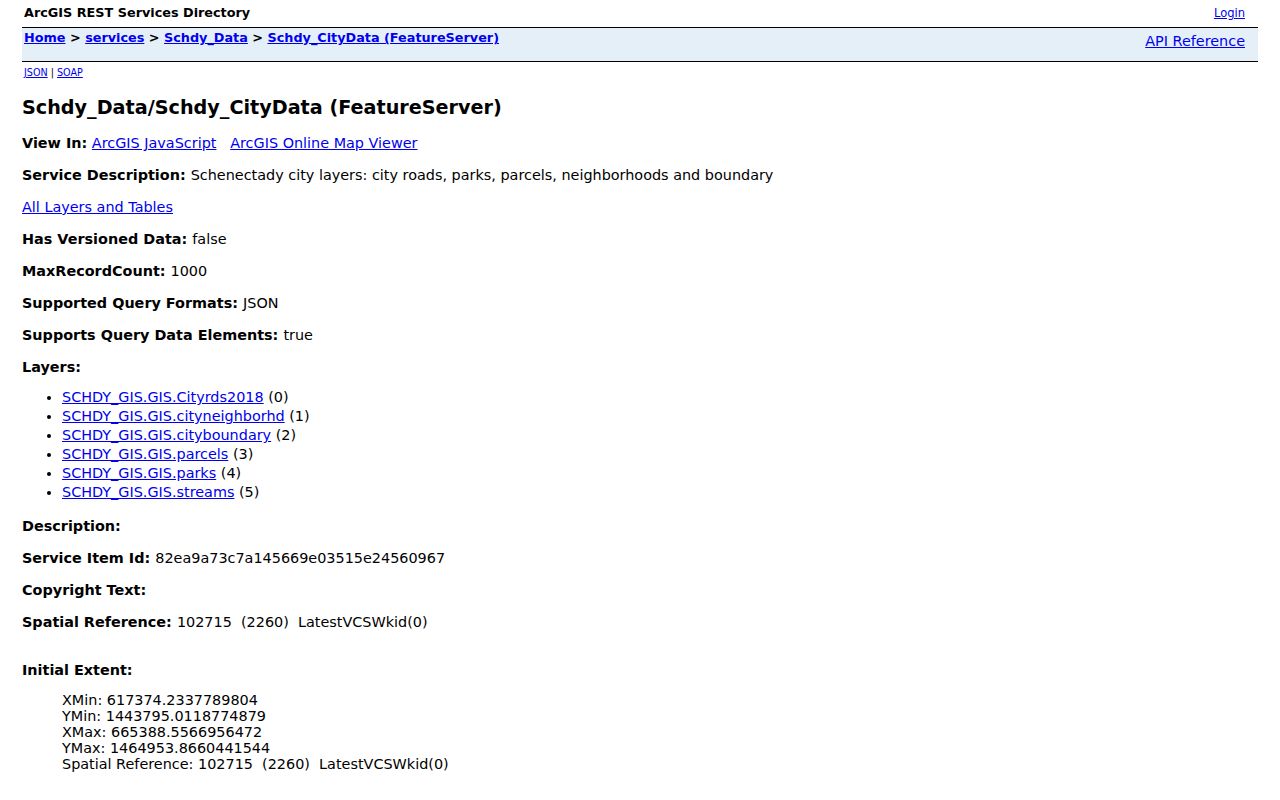
The map layer is most useful when its parcel key is carried forward to the assessment and County Clerk searches.
Schenectady County Clerk Name Index
SearchIQS is the County Clerk’s public land-record index. Party 1 and Party 2 searches can be combined with a date range, and a partial first name broadens the result set. The county guide permits an asterisk as an unlimited wildcard. A result asterisk indicates that an image is available, but image viewing or printing can carry a fee. The guide also warns that a red result date can mark an unverified document, which is a prompt to check the Clerk rather than assume the entry is final.
| SearchIQS control | What it does |
|---|---|
| Party 1 / Party 2 | Find a person or company indexed to a recorded instrument. |
| From / To date | Narrows the recording-date range; a blank end date reaches the current date. |
| Ignore party type | Searches a name without limiting it to one party side. |
| View / Print | Opens a selected result; an asterisk signals an available image. |
Online starting coverage has not been published by the County Clerk. Older deed books, counter research, clerk copies, and the local-history collections remain part of the Schenectady residents directory process.
Current Schenectady Resident Directory Sources
Current public sources have narrow functions. An assessment roll can identify the record owner and tax mailing address. A voter lookup is a match tool, not an open street roster. A recorded instrument names parties to a transaction. Court, business, and professional records can help distinguish a same-name person, but each has separate privacy rules. The table shows what the principal Schenectady residents directory sources can and cannot establish.
| Local source | Useful identity clue | Custodian | Access path |
|---|---|---|---|
| Assessment roll and Beacon | Owner, situs, mailing address, parcel key, assessment fields | City Assessor / County Tax Service | Current roll and county-linked portal |
| New York voter match | Limited registration match using county, name, birth date, and ZIP | State and County Board of Elections | Public form, supervised list route |
| County Clerk SearchIQS | Parties, recording date, instrument reference, legal description | Schenectady County Clerk | Free index, counter and copy routes |
| eCourts and clerk files | Public case caption, number, dates, and status where available | New York courts | Portal plus the clerk-held file |
| Library and archive holdings | Historical address, occupation, newspaper, census, or obituary clue | SCPL and Historical Society | Online, library, and appointment access |
The source should match the question. The Schenectady resident lookup route is designed for corroborating one person across these limited records, while address research belongs on the street directory route.
Schenectady Voter Records Need a Purpose
The New York Voter Registration Search asks for County, last name, first name, date of birth, and ZIP, with cookies and JavaScript required. It is a match interface. It does not create a downloadable list of everyone in a Schenectady ZIP or on a street. Election Law sections 3-220 and 5-602 make specified registration records and annual district lists available under supervision, while withholding driver-license numbers, non-driver ID numbers, Social Security numbers, and facsimile numbers.
For a lawful election-record request, start with the Schenectady County Board of Elections. The annual list can be organized by residence address or alphabetically and marks inactive or new voters, but voter-registration data requests carry an elections-purpose certification rule. Protected Address Confidentiality Program participants can use a substitute address. A missing match therefore may reflect a protected record, a spelling issue, or a ZIP mismatch.
The state voter-registration search is the official match tool used as one limited check in Schenectady resident research.
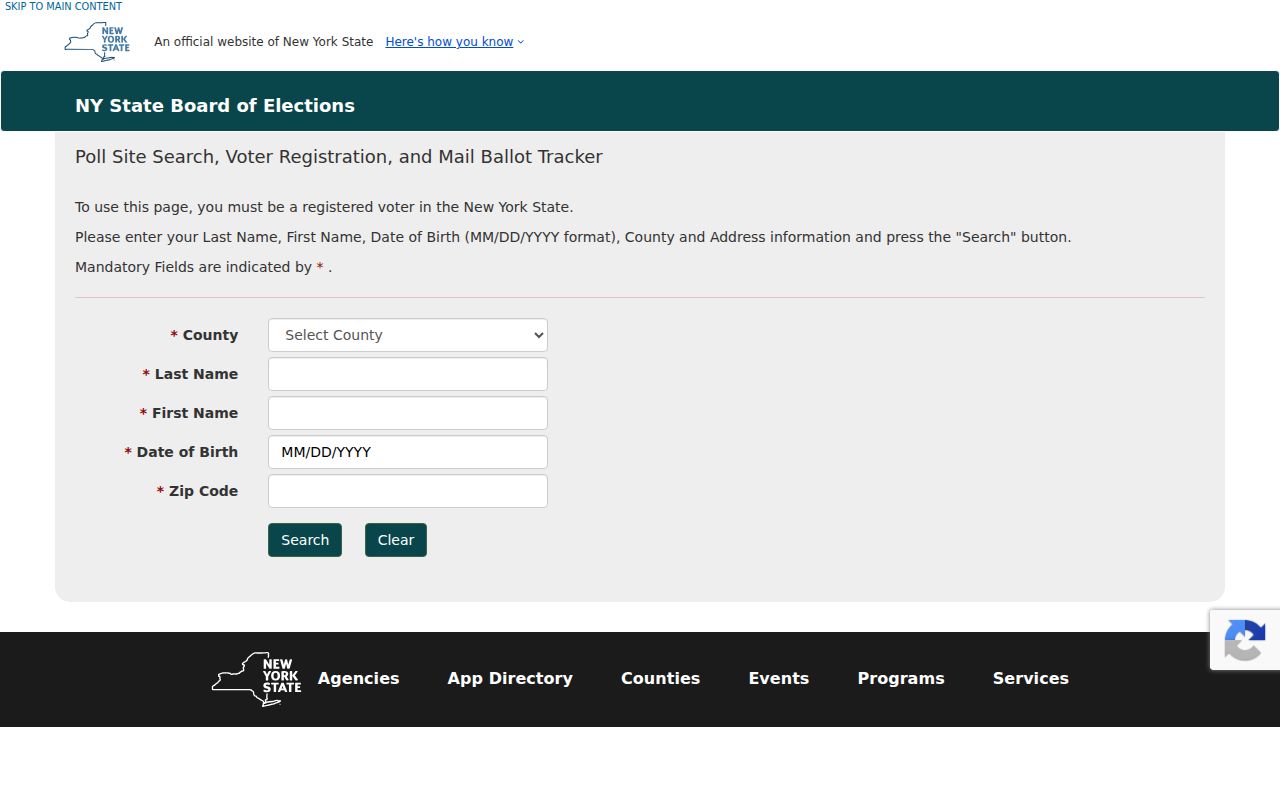
Use a voter result as a dated civic-record confirmation, never as proof of every person at an address.
Schenectady Courts, Estates, and Names
New York eCourts divides access among WebCivil Local, WebCivil Supreme, WebFamily, eTrack, and NYSCEF. A Schenectady name search may be narrowed by party, attorney, judge, county, case type, date, or case number depending on the interface. A visible result can show a caption, court, filing or appearance dates, judge, and status. It is not a guarantee that the full file is public. Sealed, youth, adoption, Family Court, and other protected matters may not display.
For an estate or heir question, Schenectady Surrogate’s Court at 612 State Street holds the court route for probate files. Combine a dated obituary or deed clue with the estate index, then ask the clerk about the file, archive, redactions, and copy options. A probate name is not a current-address result. Federal matters are separate through PACER, which is a case and document system rather than a residents directory.
Schenectady Obituary Indexes and Library Shelves
Schenectady County Public Library holds local newspapers dating to 1822, census microfilm for the county from 1790 through 1930, city and county directories, atlases, yearbooks, and the American Deaths and Marriages reel. The reel indexes about 40,000 notices from roughly 65 newspapers between 1784 and 1829. The Digital History Archive provides an online obituary and death index with specific date gaps, so a blank search means the coverage should be checked before drawing a conclusion.
The archive’s displayed combined citation count changes as entries are added. Its value is the indexed date, newspaper code, page, maiden-name notation, death notice marker, and related clue, not a permanent number. Pair an index line with the newspaper, directory, or court record for the period being researched.
Schenectady County Public Library’s local-history resources identify the directory, census, newspaper, and yearbook fallback channels.
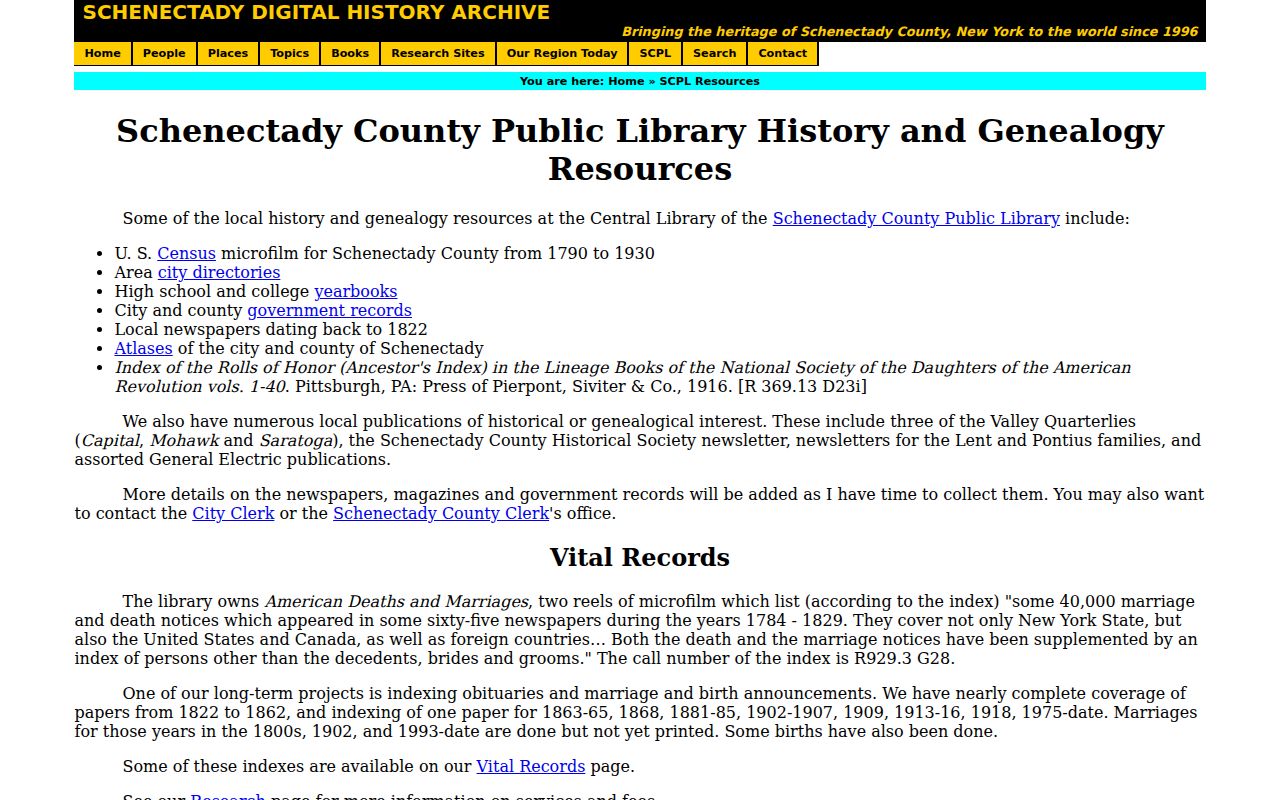
These shelves add historical context when a current online property or voter result reaches only the present.
Schenectady Records Since the GIS Expansion
County Economic Development and Planning says its GIS and SIMS expansion has been underway since 1992, serving E-911, elections, public health, real property, emergency management, and other county work. The city now publishes parcel, road, neighborhood, boundary, park, and stream layers. That growth explains why a modern address can be cross-checked through a map key, even though older deeds and directories use different descriptions and the County Clerk has not published an online index cutoff.
Use the historical map, legal description, and directory street listing to bridge time periods. The same parcel may have a modern print key, a deed description, an atlas reference, and an old printed street number. Record each form rather than silently treating them as identical.
Schenectady Official Records Versus Compiled Leads
Compiled name-and-address services can be useful only as a lead, because they may combine same-name people, carry a stale address, omit protected records, or repeat an error. The strongest Schenectady residents directory research returns to the original source. Free online index access also differs from obtaining a usable copy, and a library shelf can be more valuable than an online result with an unknown start date.
| Route | Strength | Limit to remember |
|---|---|---|
| County or state source | Dated, named custodian and defined record type | May be partial, protected, or office-only |
| Library or archive collection | Historical context and original printed runs | Coverage gaps and on-site or appointment access |
| Compiled commercial lead | May suggest a record to verify | Can be stale, merged, or incomplete |
Schenectady FOIL and Counter Routes
New York’s Freedom of Information Law is Public Officers Law Article 6, sections 84 through 90. A request should reasonably describe the record. An agency must generally make a record available, deny it in writing, or acknowledge the request within five business days. The standard copy fee is 25 cents per page up to 9 by 14 inches, and FOIL does not impose a general search or administrative fee. The county has an electronic FOIL request form; City Hall has its own request route for city records.
FOIL is a fallback for a defined record, not a substitute for a public index. State the record type, person or address, date range, department, and whether inspection or copies are sought. For land records, certified copies, older books, or indexing questions, the County Clerk counter is the more direct channel. For city permits and code files without a published case search, name the address and date range in a city request.
The County FOIL form provides an online request channel when a Schenectady record is not available through its normal custodian portal.
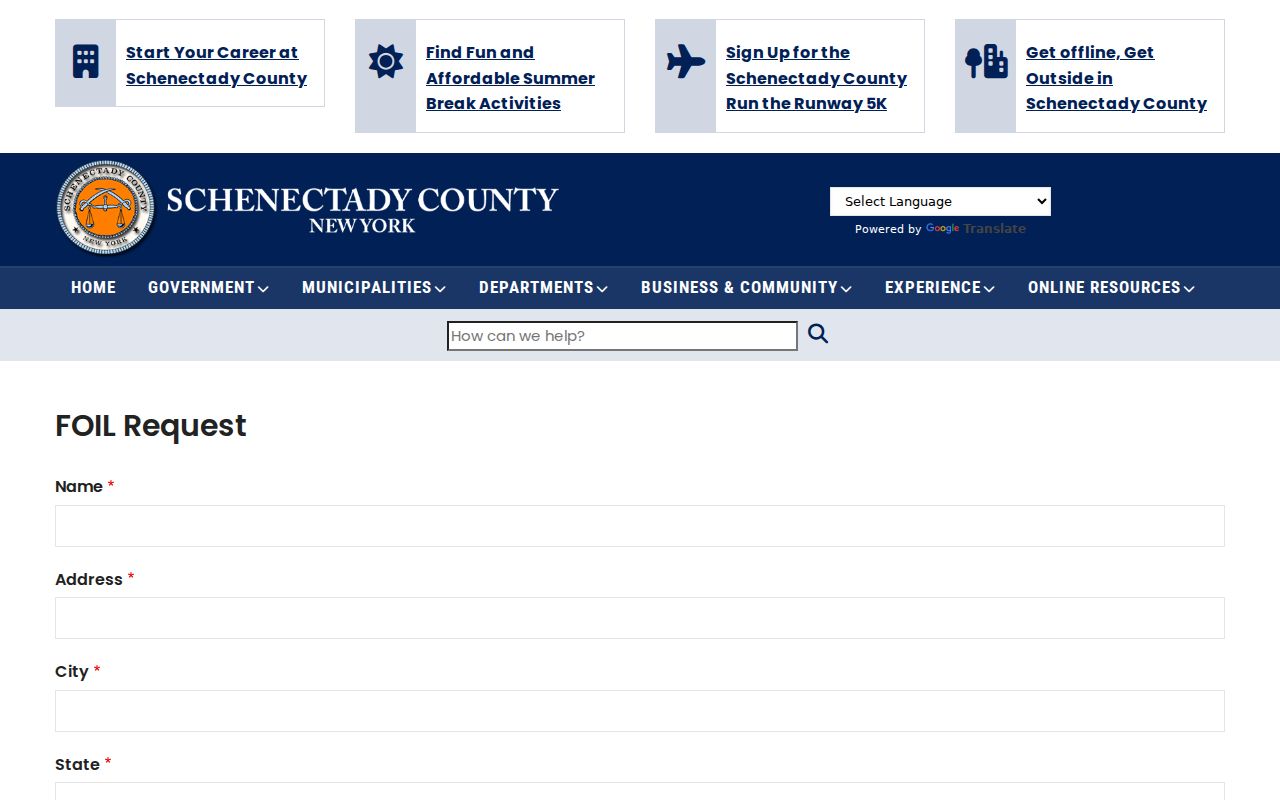
A focused request preserves the public-record boundary without pretending that an absent portal is a missing record.
Historical Schenectady Resident Directories
Schenectady’s first identified city directories date to 1841–42 and 1857–58. The local holdings list a city run from 1861 through 1968 with gaps in 1903, 1917, 1922, 1932, 1934, 1944, 1946, 1948, 1950, and 1967. The library also holds telephone books from 1961 and reverse or criss-cross directory material from 1967 onward, with the current endpoint to be verified in the holdings list. Each volume is a year-specific snapshot, not a complete household census.
The digitized archive makes the 1841 and 1860 directories a useful start. Schenectady County Historical Society adds deeds, maps, wills, cemetery records, and newspapers through its appointment-based Grems-Doolittle Library. The full collection and tracing method are on the Schenectady city directory collections page.
The digitized 1841–42 directory lets a Schenectady residents directory search move between a name entry and its linked street listing.
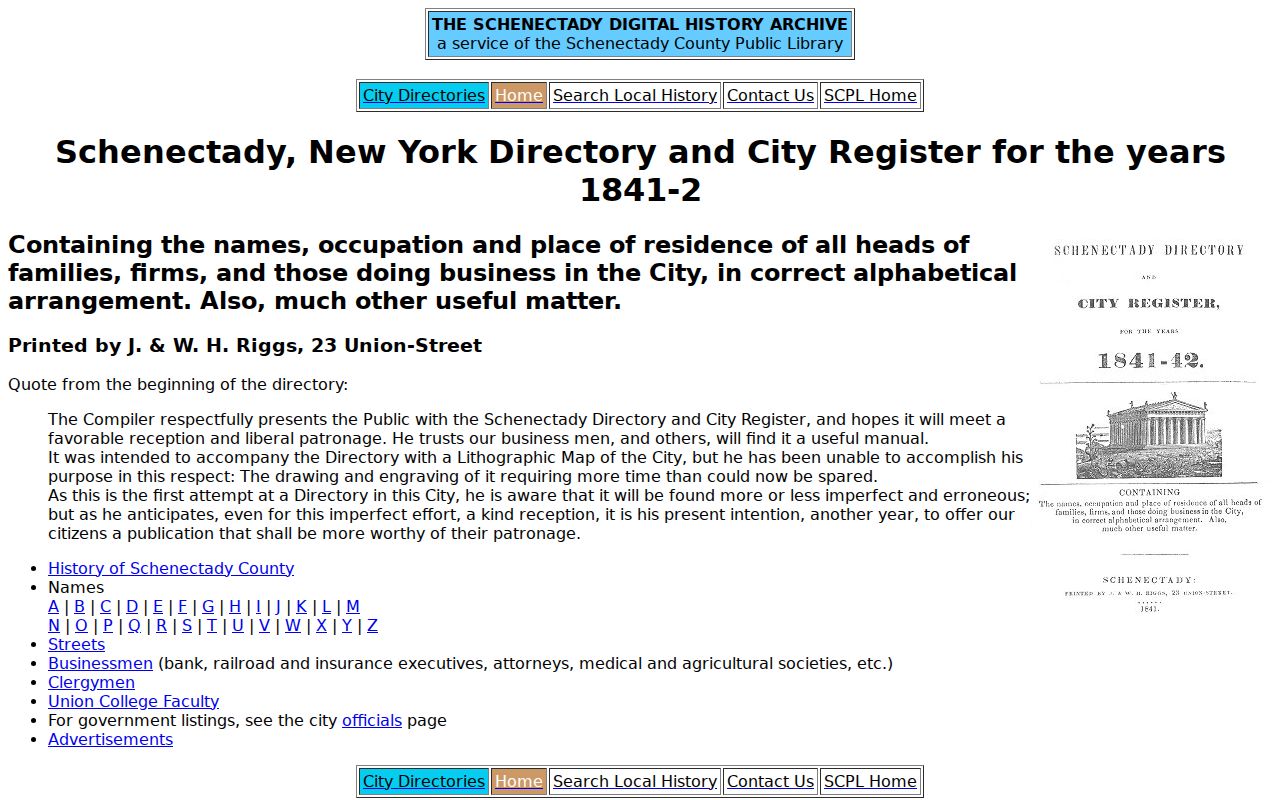
Older entries can distinguish a residence from an office, boarding place, partnership, or widow notation, which is why each line needs context.
Schenectady Historical Society Research Paths
The Schenectady County Historical Society’s collections bring together city directories, deeds, maps, family files, church records, wills on microfilm from 1809 to 1901, and newspapers on microfilm from 1795 to 1875. The Grems-Doolittle Library requires an appointment at least two business days in advance. Its catalog and finding aids are useful before a visit, especially where an early map, local organization record, or surname file can connect a directory result to a place.
For periods before Schenectady County was established in 1809, the house-history guidance points researchers to Albany County ledgers and originals at the Albany County Hall of Records. That jurisdiction change is a practical explanation for an early deed or name that is absent from a county-only search.
The Historical Society collections show the local paper, map, deed, will, and directory paths that support an older Schenectady trail.
Appointment research is the local fallback when a digital index cannot answer a dated family or parcel question.
Schenectady Dates, Gaps, and Protected Records
Every Schenectady residents directory result needs both a source date and a record date. The 2026 assessment roll is a dated property snapshot. A deed has a recording date. A voter lookup is a live match tool. A nineteenth-century directory records what its publisher printed for that year. Public Health Law section 4174 restricts vital records, and the New York Address Confidentiality Program can substitute a protected person’s mailing address. A missing entry may reflect a record gap, a protected file, a boundary change, or an index variation.
- Roll
- A dated official list, such as an assessment or voter list, with its own legal scope.
- Index
- A finding tool that identifies a record; it is not always the underlying image or certified copy.
- Criss-cross directory
- An address-to-occupant reference volume used for a particular historical period.
- Parcel
- A mapped piece of land identified by a tax or legal key, distinct from a household.
Keep uncertainty visible. That practice prevents a current parcel owner, an old directory occupant, and a voter match from being treated as the same fact.